
| Track | Album |
|---|---|
| The Butterfly | The Bothy Band 1975 |
| Pretty Peg / Craig’s Pipes | The Bothy Band 1975 |
| Do You Love An Apple | The Bothy Band 1975 |
| Tiocfaidh An Samhradh | Old Hag You Have Killed Me |
| The Maid Of Coolmore | Old Hag You Have Killed Me |
| Fionnghuala | Old Hag You Have Killed Me |
| The Factory Girl | Out Of The Wind Into The Sun |
| Casadh An tSúgáin | Afterhours |
| The Death Of Queen Jane | Afterhours |
| The Kesh Jig / Give Us A Drink Of Water / Famous Ballymote | Afterhours |
| Bonus Track | |
| Garret Barry’s / The Bucks Of Oranmore | Live In Concert |


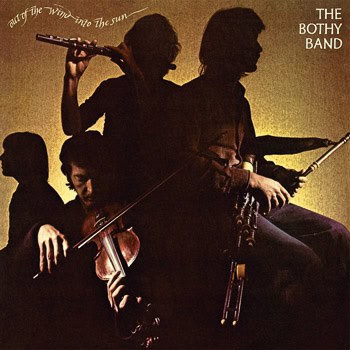
By general consensus, the Bothy Band are regarded as one of the finest of the many talented groups which emerged from the third wave of the folk music revival in Ireland (the first wave had been made up of exceptional individual talents like Seamus Ennis, Willie Clancy, Joe Heaney and Seán Ó Riada while the second had consisted of the great popularising bands like The Clancy Brothers and The Dubliners). Indeed, for me at least, the group were second only to Planxty in the contribution they made to Irish folk music in this period.
By the time the Bothy Band came together in late 1974, all of its initial members had already served several years’ apprenticeship on the Irish folk music scenes. The best known of them, Dónal Lunny, had only recently left Planxty, arguably the greatest Irish folk group ever. Of the other initial members, Matt Molloy was widely acknowledged to be the best Irish traditional flautist of his generation. Paddy Keenan, who came from a family steeped in the Irish travelling community’s piping tradition, was one of the most exciting, free-spirited and technically gifted of the younger generation of uilleann pipers then coming through on the Irish folk scene.
In its early stages, the group also included the superb fiddler, Paddy Glackin, and the brilliant accordionist, Tony McMahon. Soon afterwards, the brother and sister combination, Mícheál Ó Domhnaill and Tríona Ní Dhomhnaill, joined the group. Although they grew up in County Meath, in their youth the siblings spent a lot of time in County Donegal, where they had strong family connections. Through their extended family there (especially their aunt, Neillí) they had access to a vast store of traditional songs both from the province of Ulster and from Scotland. Such songs later formed a very important component in the band’s music. Before joining the Bothy Band, they were involved in the group, Skara Brae, which had recorded one extremely influential self-titled album in 1971. One of the songs from it, the beautiful An Cailín Rua, can be heard here.
This fledgling line-up of the Bothy Band was initially known as Seachtar (the Irish word for seven). However, when McMahon and Glackin left the group, Mícheál Ó Domhnaill suggested that they take on the name, the Bothy Boys, and the others accepted it. A ‘bothy’ was the name of the rough temporary shelters in which Irish seasonal labourers stayed when working in Scotland. They were also places where Irish and Scottish labourers traded songs and stories. When Paddy Glackin decided to leave the group, Tommy Peoples, the great Donegal fiddler, replaced him. In consequence, he played on the group’s debut album, first released in 1975.
From its very first live performances, what stuck people most about the band was the sheer power and energy of its sound. This was partly based on the rock-solid foundations, which Dónal Lunny on bouzouki and guitar, Mícheál Ó Domhnaill on guitar, and Tríona Ní Dhomhnaill on harpsichord and clavinet (where she sometimes played a similar role to that of a bass player in a rock band), gave to their music. On this scaffolding, the group’s other musicians, Keenan, Molloy and Peoples, were able to add their filigree work/instrumental embroidery which greatly enhanced it. Along with this there was Lunny’s supreme skills as an arranger with his keen eye for the broader architecture of each piece they played. This skill was immediately noticeable on my first choice, The Butterfly, where the brilliantly intricate interplay of the individual musicians is an instant joy to hear.
Tríona’s skills as a superb interpreter of folk songs is demonstrated in my next two picks, Do You Love An Apple and Pretty Peg. The latter song seamlessly leads into the instrumental piece, Craig’s Pipes, which features some brilliant playing by Keenan, Molloy and Peoples.
In the following year, Tommy Peoples, who was wary of the demands which the touring life would impose on him, left the group. The London-born fiddler, Kevin Burke, replaced him. Burke’s parents were from County Sligo and, from an early age, his playing was firmly based on the fiddling style from that county. He also spent a good deal of time in Ireland in his youth where he slotted easily into playing with local musicians. While with the Bothy Band, he also developed an easy musical rapport with Mícheál Ó Domhnaill which continued after the group split. His playing was more mellow than that of Peoples and this gave the group a slightly more relaxed and less full-on approach than it had up to that point.
Burke’s fine playing was a key feature of the group’s second album, Old Hag You Have Killed Me, first released in 1976. My first selection from it is Mícheál’s lovely version of the old Irish ballad, Tiocfaidh An Samhradh (two slightly different translations are here and here). It also demonstrates Mícheál’s beautifully understated and sensitive style of guitar playing. His vocal here also has a similar combination of subtlety and deep feeling.
On my second pick, The Maid Of Coolmore, Tríona demonstrates a similar mastery of ballad singing. She also beautifully captures the intense poignancy of the story told in the song. By contrast, Fionnghuala is a gloriously catchy piece of what could be termed ‘mouth music’. A translation of the mostly nonsensical words of the song can be found here.
By this point, the band’s ‘big’ sound and electrifying live performances were winning them a large audience both in the UK and across the European continent and even in the United States. They were now playing the folk festival circuit in places such as Rotterdam and Leiden. They also performed in predominantly rock venues like the Rainbow Theatre in London and did sessions for John Peel’s radio show. In this way they were drawing entirely new audiences to Irish folk music. At the same time, the group’s financial position remained rather precarious. They were also beginning to find the business side of their heavy touring schedule increasingly wearing. Over time such pressures – and the stresses/temptations of life on the road – led to some tensions within the group as to their future musical direction.
This growing sense of disillusionment was never apparent, however, either in their recordings or live performances. Indeed, their last studio album, Out Of The Wind Into The Sun was one of their very best recordings. From it, my pick is The Factory Girl, another of those poignant yearning ballads, which Tríona handled with typical consummate ease.
The Bothy Band’s final release in their first phase was the brilliant live album, Afterhours. This ranks high among the very best live recordings ever made by an Irish folk group. My first choice from it, Casadh An tSúgáin (a rough translation would be The Twisting Of The Rope), is an old Irish folk song with a remarkably beautiful melody. Mícheál’s rendition of the song has a remarkable delicacy and poignancy to it. It also demonstrates how the group could shift from being a musical powerhouse in the faster tunes to playing with the type of restraint and sensitivity which they display here. Mícheál gives a similar brilliant vocal performance on the group’s rendition of the old English ballad, The Death Of Queen Jane. It also shows his complete mastery of the long narrative song. Paddy Keenan’s pipe solo here is also one of the best you will ever hear.
If I were to pick one track which defined the Bothy Band’s sound – and their brilliance as a live act – I would choose the next selection, The Kesh Jig / Give Us A Drink Of Water / Famous Ballymote. On it all of the group’s strengths – their power, their technical virtuosity, the marvellous ways in which the individual musicians weaved around one another – reach a new and even more sublime level.
Given its brilliance, it is hard to think of a better way in which to finish this piece. Along with Planxty, the Bothy Band played a vital role in restoring Irish folk music to its proper place in Ireland itself and in introducing international audiences to its many riches. They remain one of the greatest groups of any kind to have emerged from Ireland.
Bonus Track
Will conclude with this brilliant piece of solo piping by Paddy Keenan. If Séamus Ennis’ version of the ‘Bucks’ remains my favourite, Paddy’s runs it pretty close.
Couldn’t finish this piece without referring to Kevin Burke and Mícheál Domhnaill’s brilliant version of Lord Franklin. It was on their duet album, Promenade, which was released shortly after the break-up of the Bothy Band. For me, it is the definitive version.
The chapter on Paddy Keenan in Colin Harper and John McSherry’s book, “The Wheels Of The World: 300 Years Of Irish Uilleann Pipers” was an indispensable source for this piece.
This programme documenting the rehearsals which led up to the Bothy Band’s reunion concert in 2024 which appeared on Irish television was also an extremely useful source – it is in Irish but English subtitles are available.
This documentary on Paddy Keenan is also well worth watching.
The Bothy Band at Compass Records
Tríona Ní Dhomhnaill official website
Mícheál Ó Domhnaill (1951-2006) tribute site
Tommy Peoples (1948-2018) tribute site
Adrian Scahill reviews The Return of the Bothy Band (2024)
A Rock’n’Roll Band in Folk Clothing (FolkWorld)
The Story and Legacy of The Bothy Band (1974-79)
“The Wheels Of The World: 300 Years Of Irish Uilleann Pipers” (extract)
Bring Back the Bothies
By Earle Hitchner – article published in the Irish Echo 1996
A Quiet Man – Mícheál Ó Domhnaill, 1951-2006
By Earle Hitchner – article published in the Irish Echo 2006
Remembering the Bothy Band – An Interview with Paddy Keenan
Podcast for the Journal of Music with Toner Quinn
Dónal Lunny: A legend ahead of his time
Irish Post article (2014)
Tríona Ní Dhomhnail speaks about her Donegal roots
Interview with Declan Magee for Donegal Live, Feb 2019
Andrew Shields is a freelance historian, who grew up in the West of Ireland and currently lives in Sydney, Australia. Along with an interest in history, politics and literature, his other principal occupations are listening to and reading about the music of Bob Dylan and, in more recent years, immersing himself in the often brilliant and unduly neglected music of Phil Ochs.
Andrew’s series of posts on Irish folk and traditional musicians on this site includes: Séamus Begley, Clancy Brothers, Willie Clancy, Sonny Condell, Dubliners, Johnny Duhan, Séamus Ennis, Joe Heaney, Seán Keane, Iarla Ó Lionáird, Seán Ó Riada, Planxty.
TopperPost #1,186
 Vulfpeck


They were an incredible lineup. While I agree that only Planxty exceeds them it’s a close race. Thoroughly enjoyed the list.