
| Track | Album |
|---|---|
| Angela | High Ace To Heaven |
| Breakfast With Leonard | Time of Your Life |
| Looking For The Magic | Time Of Your Life |
| I Lied To You | Time Of Your Life |
| When It Comes To Tears | The Brilliant Architect |
| The Only Business | The Brilliant Architect |
| Sacred Ground | Crooked Highway |
| Same Old Rounds | Crooked Highway |
| Distant Starlight | Crooked Highway |
| No Train To Cavan | Crooked Highway |
| Bonus Track | |
| Train Of Love | The Brilliant Architect |
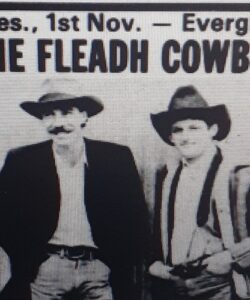
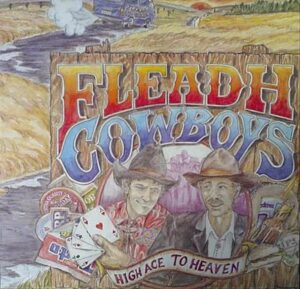
Pete Cummins’ career in the Irish music business began in his teens when he played with some of the very first ‘beat’ groups in Dublin. These included relatively short-lived bands like the Circle and the Grassband. In the later 1960s, he joined Granny’s Intentions, a group which already had a sizeable live following both in their native Limerick and subsequently in Dublin. In 1967, the Intentions had made the move to London to attempt to ‘make it’ on a much larger stage.
There, they played some of the better-known venues of the era, including the Marquee Club, and they also began to write their own songs. The best of these combined the band’s early soul influences with ones derived from folk, country and contemporary psychedelic music. These songs also demonstrated that their frontman, the late great Johnny Duhan, had considerable potential as a songwriter. They also helped to secure the band a contract with the English record label, Deram, a subsidiary of Decca. Unfortunately for the group, the recordings they made with that label achieved little commercial success outside Ireland. Cummins first became involved with the band when they were recording their debut album, Honest Injun. He played bass and flute on the record. By this point, however, Duhan’s own songwriting was moving in a folk-oriented acoustic direction and this led to increasing clashes within the group about what its future musical course should be. Eventually this friction led to Duhan leaving the band in 1971 with the remainder of its members also going their separate ways in the following year.
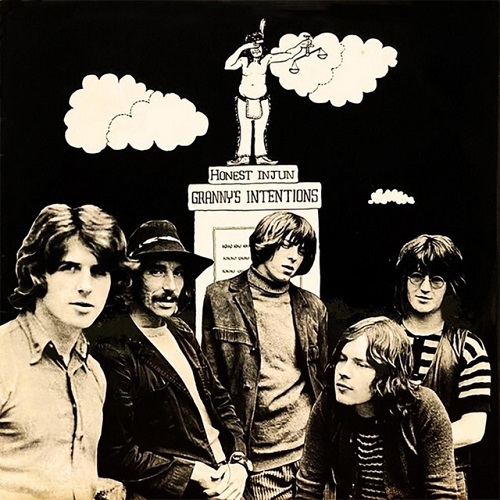
Following the break-up of Granny’s Intentions, Pete Cummins was involved in putting together an Irish touring band for Donovan. One of the musicians he recruited at that time, the guitarist, Philip Donnelly, subsequently played an important role in his own career. While playing with him, Cummins stayed for a time in the house which Donovan was renting in County Kildare. During this time the two men had the meeting with Leonard Cohen, which Cummins subsequently commemorated in the song Breakfast With Leonard (there will be more about it later in the piece). In the later 1970s, Cummins was also involved with the short-lived group, the Fake, whose frontman was the extremely talented singer, Freddie White. After it broke up, Pete spent some time in the United States before returning to Ireland in the 1980s.
His return to Ireland coincided with a series of other events which helped to pave the way for the launch of his most successful musical venture, the Fleadh Cowboys. He founded the group along with two other extremely talented musicians: Johnny Moynihan (who had been a member of the extremely influential folk group, Sweeney’s Men, along with future Planxty member, Andy Irivine, and Terry Woods, later of the Pogues) and Frankie Lane. They took their name from Moynihan’s adaptation of the Ed Bruce song Mammas Don’t Let Your Babies Grow Up To Be Cowboys. Moynihan’s version satirised the new urban audience for traditional Irish folk music which arose through the Dublin ‘ballad’ boom from the mid-1960s onwards. A rough translation of ‘fleadh’ would be festival or festive occasion and the fleadh ceol was one of the main Irish folk music festivals, held annually since 1951. Unlike previous Irish country bands, who tended to derive their sound from Nashville-type country, the Cowboys’ influences ranged from Jimmie Rodgers to Hank Williams to Bob Dylan on through cajun and bluegrass music to ‘outlaw’ and alt-country. They were particularly influenced by Joe Ely’s blend of country and rock elements and by the wider Texan school of songwriters which developed around Townes Van Zandt and Guy Clark.
The founding members’ diverse range of influences also shaped their sound, with Cummins coming from a rock and soul background, while Moynihan had been a prominent member of the Irish folk scene. As a result, the band were never mere copyists but rather performed a kind of alternative country music shaped by an Irish sensibility. Having recruited new musicians including Jimmy Faulkner on guitar, Garvan Gallagher on bass and Fran Breen on drums, they began playing gigs on the Dublin pub and clubs circuits. Eventually, they secured a residency at the Harcourt Hotel there and began to develop a reputation as one of the best live acts in the city. They also benefited from the fact that a lot of their audience had been attracted to country music by ‘class of ˈ85’ artists like Randy Travis, Dwight Yoakam and Lyle Lovett rather than by more traditional Nashville acts.
Around this time, Philip Donnelly also returned to live in Dublin after spending many years in the United States. After playing with Donovan’s backing band for several years, he had gone on to develop a reputation as a leading session musician in Nashville. During this period, he played on numerous albums by artists like Townes Van Zandt, Guy Clark, John Prine, Nanci Griffith, Don Williams, and Don Everly. On his return to Ireland, he started a music programme known as The Sessions, which featured several of those artists he had played with in the US. Among the musicians he asked to perform in the backing bands on those shows were Cummins and other members of the group. There is more detail on the show’s history here.
Three members of the Fleadh Cowboys – Pete Cummins, Garvin Gallagher, John Ryan (who joined the band on keyboards after Johnny Moynihan left in September 1986) – can also be seen in this clip from the show – featuring John Prine – from 1987. The associations he built up at this time also led to Cummins appearing on Nanci Griffith’s duet album, Other Voices, Other Rooms. On it, he sang Ralph McTell’s From Clare To Here with her. Philip Donnelly also played guitar on the track. Cummins also played on Townes Van Zandt’s last studio album, No Deeper Blue, which was recorded in Ireland in 1994. Pete can be seen doing a fine version of one of the songs from it here.
The ‘buzz’ that was developing around the Cowboys in this period was augmented when they began a residency (known as ‘Midnight at the Olympia’) in the theatre of the same name in Dublin. The shows began at twelve, which meant that artists who were playing gigs elsewhere in the city could join them on stage once their own concerts had finished. This became a staple part of the gigs. Among the artists who took advantage of this were those of the stature of Joe Ely, John Prine, Nanci Griffith, Shane MacGowan and the Waterboys.
Having been present at several of these, I can confirm that everything said about the Cowboys being a superb live band is true. Indeed, as Pete has said, at that stage the band was so tight that they could have played with just about anybody. During this time, the line-up changed quite regularly but the musical calibre of its members remained consistently high. Among the fine musicians who played or sat in with the group at this time were guitarists like Jimmy Faulkner, who went on to play with Christy Moore, and Henry McCullough, who previously had stints with Spooky Tooth and Wings.
Like many great live bands, it proved difficult for the Fleadh Cowboys to capture their particular magic on record. Nevertheless, the two albums they recorded, the Philip Donnelly-produced High Ace To Heaven and Time Of Your Life contain some very fine music. Angela, my pick from the first of these, is one of Cummins’ most obviously commercial songs . It also features some tasty interplay between Philip Donnelly on lead and Frankie Lane on steel guitar.
Breakfast With Leonard, from the group’s second album, ranks high among Cummins’ best songs. It features an extremely clever arrangement, which mimics Leonard Cohen’s characteristic musical style (particularly in the female backing vocals). The lyric is also full of memorable lines (a voice that spoke like centuries beginning to decay, do you feel it? does it bleed you? does it torture you inside?). It also manages to make some important points about art and the artistic life in a short space of time without veering into pretentiousness.
By contrast, Looking For The Magic captures something of the visceral excitement which was central to the Cowboy’s live sound. It also features some typically excellent dobro and fiddle playing by Frankie Lane and Paul Kelly (who joined the group in 1989) respectively. I Lied To You is an example of Cummins’ droll wit and features some fine fiddle playing by Kelly. Here’s a live performance of the song.
Pete Cummins released his first solo album, The Brilliant Architect, in 2008. My first pick from it, When It Comes To Tears, is one of his best rockers. It also features some stinging guitar work by Pete himself and Ger Kiely.
The Only Business from the same album is a far more meditative song which also features one of Pete’s best lyrics.
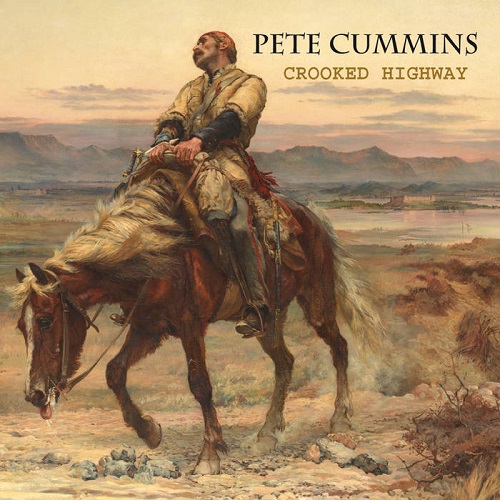
My final selections come from Cummins’ second solo album, Crooked Highway, first released in 2014. The first of these selections, Sacred Ground is a Neil Young-esque lament for Cummins’ friend, the journalist, Eugene Moloney, who died after an unprovoked attack in Camden Street in Dublin in June 2012. The second, Same Old Rounds is a classic country ballad, albeit one with a slight soul-tinge. Distant Starlight has a nice laidback groove, while my final selection No Train To Cavan is a cover of a Lisa O’Neill song which Cummins makes very much his own.
As these selections demonstrate, at his best Pete Cummins is an excellent songwriter. Given this, it is unfortunate that he has never quite received the credit he deserves, even in Ireland. For those of us who were around the Dublin gig scene in the late 1980s and early 1990s, he and his fellow Fleadh Cowboys also provided lasting memories of gigs that were both hugely entertaining and musically of a very high standard. Going by a recent interview, Pete also continues to play the occasional gig and occasionally to busk in the Dublin suburb of Howth where he lives. Both in his work with the Cowboys and in his solo work he also brought a new audience to what could be termed ‘real’ country/Americana music. In doing so, he made a major and lasting contribution to Irish music in general.
Bonus Track
The bonus track, Train Of Love, is a fine cover of the Johnny Cash classic. It has a nice Tex-Mex feel which is augmented by Trevor Knight’s excellent accordion part.
The fine compilation, Lookin’ For The Magic, gathers together most of the best of Cummins’ solo work and his work with the Cowboys. It is currently probably the easiest way to access his work.
2025 audio interview with John Connell Part 1 (of 3)
Irish Rock Discography: Fleadh Cowboys
Interview with Colm O’Hare of Hot Press (2001)
RTE’s ‘The Session’ List of Programmes (1987-1988)
Pete Cummins page and related pages at Muso.ie
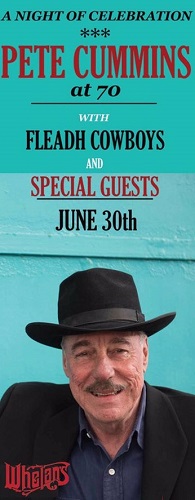
Pete Cummins at 70 (Celebration gig at Whelan’s + videos)
Fleadh Cowboys featuring Frankie Lane (YouTube)
Andrew Shields is a freelance historian, who grew up in the West of Ireland and currently lives in Sydney, Australia. Along with an interest in history, politics and literature, his other principal occupations are listening to and reading about the music of Bob Dylan and, in more recent years, immersing himself in the often brilliant and unduly neglected music of Phil Ochs.
TopperPost #1,181
 Chet Atkins


Thanks Andrew! I’ve always been curious about The Fleadh Cowboys and Pete Cummins. Mike Scott has only recently posted, on his Patreon page, a couple of old recordings featuring Frankie Lane on dobro. Philip Donnelly is mentioned a fair bit in the most recent bio of the Everlys by Barry Mazer which I read last week. I feel as though your article is one more sign that I need to hear some of this music! As always, a detailed and thoughtful post.
Tony thanks for the kind words. Just realised my two most recent Toppermosts were both on artists with close connections to Mike Scott – Pete and Séamus Begley. Also should have mentioned Frankie Lane’s fine solo album Dobro here. On it – funnily enough – he plays a few bluegrass classics, Irish traditional music and even a Chopin nocturne on the dobro.Thanks again…