
| Track | Single / Album |
|---|---|
| Trouble Bound | Sun 245 |
| Rock With Me Baby | Sun 245 |
| Flyin’ Saucers Rock And Roll | Sun 260 |
| I Want You Baby | Sun 260 |
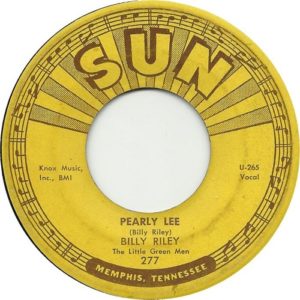
| Red Hot | Sun 277 |
| Pearly Lee | Sun 277 |
| Baby Please Don’t Go | Sun 289 |
| Wouldn’t You Know | Sun 289 |
| One More Time | Sun 322 |
| They Call Me Lazy | Shade Tree Blues |


Billy Lee Riley playlist
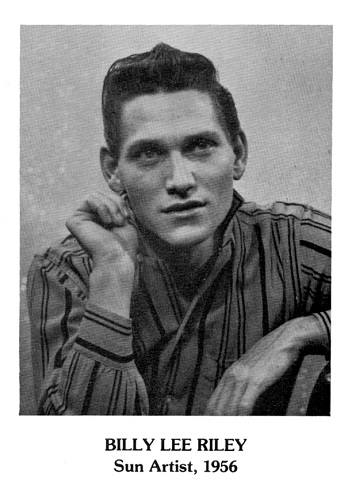
Billy Lee Riley never forgave Sam Phillips for pulling the promotion on his record Red Hot and switching it to Great Balls Of Fire from Jerry Lee Lewis. If you’ve ever seen the lengthy documentary on Sun Records which crops up every now and then on Sky Arts then you’ll have seen Billy still bitter after all those years. Who knows? He might have been right. Red Hot was a mighty good record though it doesn’t quite stack up against “Great Balls”, and Billy might have been launched into stardom or at least a day in the sun.
William Lee Riley was born in Pocahontas, Arkansas on 5th October 1933. With a background of poverty, his family was semi-permanently on the move. He learned both harmonica and guitar at an early age and had appeared on local radio by the time he was 15. In 1949, he enlisted into the US Army staying for two stints. On his discharge he got more involved in music via bands working in the Jonesboro, Arkansas area. He moved to Memphis and, after an attempt to open a restaurant, he tried to resuscitate his musical career. He impressed Jack Clement, who, at that time was a singer with Slim Wallace’s Dixie Ramblers, and Clement and Wallace made a record with him: Think Before You Go backed with Trouble Bound. The intention was for this to be the first release on a new label called Fernwood Records which Clement and Wallace were setting up. However, they took the single to be mastered at Sun whereupon Sam Phillips was so impressed with Billy that he offered him a contract, bought the master tapes and also offered Clement a job as producer at Sun.
Phillips wasn’t so keen on the country flavoured Think Before You Go so it was replaced by the written-almost-on-the-spot Rock With Me Baby as one side of Billy’s first release for Sun. But it was Trouble Bound that took precedence as the A-side and rightly so. For a first studio outing the track had an air of quite surprising elegance about it combining what at first hearing was an almost folksy simplicity with touches of unexpected sophistication – the switches in timing by the drummer were among these touches. Another fine component was the minimalist final line of each verse just when you were expecting a more multi-syllabic and punchy closing phrase or, to put it another way, conveying emphasis by lack of emphasis. Billy’s almost high and lonesome country vocal combined with Roland Janes’ bluesy and occasionally rocking lead guitar throughout to create one of those great Sun singles that wasn’t quite blues, wasn’t quite country and wasn’t quite rockabilly but had elements of all of them (and that was probably why Sam liked it).
The flip though, most definitely was rockabilly; Sam had called for something more punchy and he got it. Once again drummer Johnny Bernero and guitarist Roland Janes star – what about that second break! – but it’s the whole concoction topped with the icing from Billy’s vocal, containing just a faint hint of Elvis, that leaves you thinking, “Wow, that was a lot better than I expected from the rather corny title”.
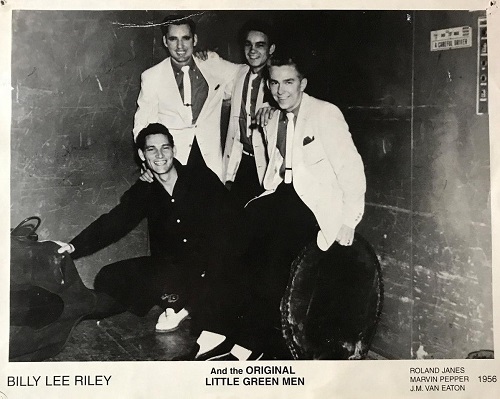
Single #2 gave the world the first glimpse of Billy Lee Riley, the man who would change his voice to match its surroundings as in chameleon, the descriptor that those good people at 706UnionAvenue just love to use about him. Billy evidently felt that something a little more like Little Richard was required on Flyin’ Saucer Rock And Roll – the pluralisation to “Saucers” was a glitch that crept in when the label was set up for printing – so enter stage left a full blooded rasp. Other features included the occasional scream which was another nod to Little Richard (and which I’ve only recently learned was overdubbed), a splendid tremolo intro from Roland and the presence of a pianist for the first time. As many readers will know, that pianist was Jerry Lee Lewis who, only a few days before had recorded the sides for his first single in the same studio (using guitarist Roland Janes and drummer James Van Eaton who appeared on the “Saucer” session).
The B-side, I Want You Baby, was much gentler with Mr. Penniman having apparently left the studio. Billy had his Rock With Me Baby voice on again and the result was just as satisfying as the far more in your face A-side (and just as full of rockabilly tropes).
Sam Phillips had the publishing rights to the A-side of Bill’s third single so would have been understandably chuffed that his new rockabilly hero went along with the idea of recording it. Originally cut for Sun in 1955 by Billy “The Kid” Emerson, Red Hot was a fine candidate for a second outing of Mr. Riley’s harsh ‘n’ raspy style. While some of the humorous subtlety of the source was excised, the call & response jump blues style – “My gal is red hot / Your gal ain’t doodly squat” – was retained, and any potential loss of impact was avoided by the absolutely superb backing team or the “Little Green Men” as they were credited.
A few words on that backing team are called for. Contrary to some people’s beliefs, that wasn’t Jerry Lee on piano; a new member of Bill’s band, Jimmy Wilson, was filling the role and doing a fine job too. On drums this time was James Van Eaton and his contribution was huge. A few months earlier, he and Roland Janes had become the backing band for Jerry Lee, both on the road and in the studio; they also would operate as a kind of default Sun house band when they weren’t on tour. Unfortunately for Roland his talent tended to be a little hidden when working with Jerry since the latter was such a dominant character, as much instrumentally as vocally. But on records like this one his ability is very apparent; not only does he give us a positively scintillating first solo but he also appears on the third break wherein he duets most effectively with sax player John “Ace” Cannon who suddenly appears out of nowhere.
Cannon is also present on Pearly Lee, the flip, but this time he’s there from the start. The mix of sax with more typical rockabilly instruments is one that works on this track, and one would presume that it impressed Billy since he had another tenor man, Martin Willis, as part of his regular team from the next record onwards. The writer at 706UnionAvenue sees a resemblance between this little ditty and Little Richard’s The Girl Can’t Help It though he/she does stress that it’s mainly in the lyrical area. I don’t see it in the overall sound but would concede that maybe some creative borrowing had been going on.
The astute reader will have spotted by now that there’s a high degree of front loading going on in my top ten – see also Footnote #1. That’s absolutely correct but what the revisit I refer to in said footnote has revealed to me is that these early singles from Billy are even better than judgements I made umpteen years ago. Mr. Riley was one of the very best even if that statement is based on a small but brilliantly performed slab of data.
Both sides of single #4 see Billy looking outwards rather than sticking with the Sun rockabilly sound:
The opening bars of his take on Baby Please Don’t Go comprising a bass and guitar in union ascending riff, plus sheer minimalism from the drummer, suggested that we might be in line for the entry of a modern jazz inclined swinger but no, Billy appears complete with his sore throated Little Richard persona. And just when you’re starting to think it might be getting a tad repetitive enter Mister Sax Man (Martin Willis) with a roar of intent. He’s followed by Roland Janes with another of those intriguing breaks which owes absolutely zero to the much better known Sun axe men like Scotty Moore and Carl Perkins. The only slight negative comment that I would apply to this track is that once again some borrowing had taken place: this time it’s the riff which isn’t a million miles away from the one heard in Gene Vincent’s Dance To The Bop. (And I have to give credit to the musical nous of someone at 706UnionAvenue for identifying that correlation which had never struck me before.)
Wouldn’t You Know is different again: Jimmy Wilson’s piano is to the fore but it’s Billy’s playful Elvis voice that you notice, so different to the A-side. For me this track has wobbled in that uncertain area of should it be in or not, but each time I replay it the expansiveness of the middle eight just slays me, and Willis’ sax was just made for it.
From my introduction the reader will have gathered that there was something of a love/hate thing going on between Billy and Sam Phillips, though this was largely in Billy’s mind (and he did speak kindly about the man in later years). Sam’s focus on Jerry Lee didn’t disappear which resulted in Billy storming out in the summer of ’58. His parting contribution was inclusion in the support (and writing) teams for a pair of instrumental jams, Thunderbird and Itchy, which were credited to Sonny Burgess only, as recording artist. Billy’s departure resulted in a single for Brunswick which coupled Rockin’ On The Moon with Is That All To The Ball (Mr Hall). The A-side was as bad as the title suggests, a poor attempt to capitalise on the tiny amount of success achieved by ‘Flyin’ Saucer’. The flip was much better, a jump blues delivered well but hardly obvious chart fodder.
He was back at Sun by early ’59 and a couple of singles were released. The sheer variety of the four tracks indicated that Billy (and probably Sun) were in search of a style. They included an attempt at rocking up the spiritual Down By The Riverside which was valiant but not of lasting interest, a hokey knees-up country item entitled No Name Girl on which Martin Willis’ sax strayed slightly into Benny Hill territory and Got Your Water Boiling which featured the Little Richard voice again but not too much of that man’s vim and vigour. That leaves one and that was One More Time, or to give it the full final line, “Come back baby, let’s try it over, one more time”. While once again some creative cribbing had been going on (from a blues called Come Back Baby, for more on which see the footnotes), but what came out the other end was something that stood on its own two feet. And something that straddled blues, country, no rockabilly this time, pop perhaps and even film themes: the opening definitely had a widescreen aura about it. One more to put in that bag that I call gorgeous Sun unclassifiables.
I would have added a further phrase to my last sentence along the lines of “… and a fitting climax to his Sun career” but he actually returned there for a third stay. He took a longer break this time, signing up again in 1969 when Shelby Singleton had bought out Sam Phillips’ whole operation. Much of the output under Singleton consisted of repackaged oldies but he did cut several Billy Lee Riley singles with tracks varying from the country funk of Kay to the more easy listening Tallahassee.
During the sixties Billy combined work as a session musician from a new base in Los Angeles with attempts to build a solo career. As in the Sun days, his muse or style seemed to lead him all over the place. Singles during the timeframe saw him taking on sweet soul music (Midnite Hour sic), dance crazes (Everybody’s Twisting as Darron Lee), pop trash (Nightmare Mash), blues (a good Repossession Blues as Lightnin’ Leon), country, which I’ve already mentioned, and more.
For me the single that really seemed to hold out promise was a solitary outing on Atlantic in 1968. The A-side, Sittin’ And Waitin’ was a vaguely countryish affair which might have come from someone like Charlie Rich and, as always with Billy, it was delivered well. Being our hero though, the flip Happy Man was entirely different in that the closest label I could put on it would be Motown oriented R&B of the type that UK Northern Soul fans later lapped up. Which isn’t a bad thing at all and might well have been indicative of Atlantic attempting to widen its market.
There were several albums too, some devoted to his harmonica skills while several others zeroed in on his live act; the “Midnite” Hour single referred to came from Billy Lee Riley – Southern Soul: Recorded Live!! At The Brave-Falcon while another single, Mojo Workout (a rebadged Got My Mojo Working), came from Whisky À Go Go Presents Billy Lee Riley. One of these so-called live albums, In Action!!!, released in 1966 was actually a fake in that the music was recorded in the studio with applause dubbed on afterwards. That’s not so say that it didn’t include some interesting tracks including a good version of St James Infirmary which also saw release as a single. The presence too of a version of House Of The Rising Sun might have suggested that Bill was attempting to move into Eric Burdon territory; the Animals were one of the biggest successes of the relatively recent Brit Invasion (though I should add that Gordon Lightfoot’s Early Mornin’ Rain also being on the album might scotch that theory).
Disillusioned with the lack of progress of his music career, Billy returned to Arkansas in the early seventies and started a construction business. However, he was enticed back into music by the revival of interest in rockabilly in the UK and Europe plus the covers of his records that started appearing from the likes of Robert Gordon. In the words of the writer in the Rockabilly Hall Of Fame he “got the bug again” and in 1979 appeared at the Memphis in May Beale Street Blues Festival. He also got back into recording and, from 1978, albums bearing his name started to appear. Over time such albums moved from being wholly or in part retro-based to ones which covered a wider variety of music with blues starting to assume some prominence. People started taking notice: 1997’s Hot Damn CD which was predominantly blues with plenty of guitar and harmonica from Billy, was nominated for a Grammy Award. His fondness for the music that was recorded at Jay Miller’s studio in Crowley, SW Louisiana for the Excello label was strongly apparent in the set (though confusingly, the Winter Time Blues on the album is not the same as the one with that title written and recorded by Lightnin’ Slim in the Crowley studio). This song, Nothing But The Devil, did originally come from Lightnin’ – “I’m gonna break out like the measles, girl I’m gonna be all over you” – and anyone who loves that man’s music, as I do, will recognise the quality of Billy’s version.
A similar atmosphere pervades the slightly later Shade Tree Blues. Once again those guys down in Crowley, Louisiana are recalled – Lazy Lester’s I Hear You Knockin’, Silas Hogan’s Dark Clouds Rollin’ and Lightnin’ Slim’s Hoodoo Woman Blues are all present – and all in very fine versions which echo the spirit of the originals without resorting to note-for-note copying.
I wanted one of my selections to reflect this late period of Billy’s work and, to be honest, I was spoilt for choice. Almost any one from Shade Tree Blues would have sufficed and there are excellent tracks to be found on virtually all of his albums from the late nineties onwards. I’ve gone for Billy’s take on another Lazy Lester number, They Call Me Lazy which, in Lester’s hands, was almost a throwaway. This is Lester. Billy Lee is below:
They call me lazy, goodness knows, I’m only tired
Billy Lee Riley died of colon cancer on 2nd August 2009 in Jonesboro, Arkansas.
But I haven’t divulged everything. A few paragraphs back I stated “People started taking notice”. One person who had been taking notice since the early years was Bob Dylan who eventually took it into his head that he had to go and find Billy. He tracked him to Newport, Arkansas in 1992, rang him up and asked him to open a show for him (Bob) in Little Rock.
Friend of Billy, photojournalist Karen Pulfer Focht picks up the story in her blog:
“One day Billy Lee called me and said that Dylan was coming to Little Rock and that he wanted Billy to come see his show. Billy said he’d like me to come too and take a few pictures for him. I was happy for the opportunity, although I felt it would probably be a long shot that we would be able to see Dylan.”
“When we got there Dylan immediately invited us onto his bus. I watched it first hand. Dylan was in awe of Billy Lee Riley. Dylan talked to him about being influenced by his music, listening to his music in his room as a kid. Dylan was so enthused, so eager to hear more. He asked Billy Lee over and over, show me how you did this and that. Dylan was thrilled to be meeting Billy Lee and honored that Billy was going to come see his show that night.”

Billy’s own reaction is documented in another blog, bobsboots.com:
“Bob said I was his favorite singer and he had been looking for me since 1985 – he’d even been to my old house in Murfreesboro, Tennessee looking for me,” says Riley. “He said he’s always admired two of my songs, Trouble Bound and One More Time. He knew more about me than I did – he reminded me that I had recorded “Like A Rolling Stone” on guitar and harmonica on an instrumental album for Mercury Records in 1965. He even knew I cut a song under another name, Sweet William.”
There was more to this story. At the 57th Grammy Awards held on 8th February 2015, Bob Dylan was honoured as “Person of the Year” by the MusiCares Foundation, a charity which aids artists in need. He gave a 30 minutes plus acceptance speech.
“Dylan was especially eloquent in discussing Sun founder Sam Phillips. He noted that Phillips’ work with the label “shook the very essence of humanity. Revolution in style and scope. Heavy shape and color. Radical to the bone. Songs that cut you to the bone. Renegades in all degrees, doing songs that would never decay, and still resound to this day.”” (source: Bob Mehr on Memphis Music Beat, 11th February 2015).
Towards the end of his speech, Dylan stated:
“I’d like to personally thank them (“them” being MusiCares) for what they did for a friend of mine, Billy Lee Riley. A friend of mine who they helped for six years when he was down and couldn’t work. Billy was a son of rock ‘n’ roll, obviously.”
“He was a true original. He did it all: He played, he sang, he wrote. He would have been a bigger star but Jerry Lee came along. And you know what happens when someone like that comes along. You just don’t stand a chance.”
and
“He was a hero of mine. I’d heard “Red Hot.” I must have been only 15 or 16 when I did and it’s impressed me to this day.”
(Source for the extracts from the transcript, the Los Angeles Times).
Bob Mehr of Memphis Music Beat also tracked down James (sometimes Jimmy) Van Eaton, drummer for Billy Lee Riley’s “Little Green Men”. He (James) was bowled over by Dylan’s speech and went on to say:
“It’s a shame that Riley never had that big breakthrough. We had really good regional records with ‘Flyin’ Saucers’ and ‘Red Hot.’ I really felt like Riley was going to be the one. That isn’t how it worked out. But it sure is nice that Dylan remembered the old boy, Riley deserves it.”
Here’s Billy performing that song in 2003:
FOOTNOTES
1. There was a degree of inevitability about the appearance of this Toppermost. I’d already produced a Topper for each of Carl Mann, Warren Smith and Sonny Burgess so fans of Sun rockabilly output from the mid to late fifties could be wondering why did it take so long to get round to Billy Lee Riley? Confession time: I never quite warmed to the late Billy Lee as much as I did to the other Sun ‘lower tier’ rockabilly wannabes like Carl Mann etc. Sure I loved his pair of classics, Flying Saucers Rock And Roll and Red Hot, but the slightly later records left me cold. I was vaguely aware that Dylan had been positive about Billy but I hadn’t investigated such comments in any depth. A revisit was definitely called for and that caused me to significantly change my opinion.
2. The documentary I refer to in paragraph 1 was made to accompany an album made in 2001 called Good Rockin’ Tonight – The Legacy Of Sun Records with contributions from Paul McCartney, Bob Dylan, Eric Clapton and many more. The film which was released in the same year and had a generous duration of 1 hour and 52 minutes, contained a mix of Sun Records history and clips made to promote the album but with the bulk devoted (quite rightly) to the former with plenty of input from the Sun ‘minor artists’ most of whom are with us no more.
3. Billy didn’t use his middle name “Lee” on record label credits until 1963 when, according to 45cat, it appeared with a song entitled Nightmare Mash on a label called Enterprise out of Denver, Colorado (with the number undoubtedly having some relationship to Bobby “Boris” Pickett’s Monster Mash).
4. As I explained in a footnote to the Bob Luman Toppermost, the song Red Hot was originally a cheerleader’s chant for Billy Emerson’s school football team. Merely substitute “our/your team” for “my/your gal” in the lyrics and you’re part way there:
My gal is red hot
Your gal ain’t doodly squat
The repeated second line, “Your gal ain’t doodly squat”, typically sung by members of the backing band, was a common device in forties and fifties jump blues. The same stylistic approach was carried through to the version of the song from Billy. The later version of the number from Bob Luman with James Burton on guitar certainly wasn’t without merit.
5. It was Sam Phillips who came up with the “Little Green Men” name for Billy’s backing band, with the result that both Flyin’ Saucer Rock And Roll and Red Hot were credited to Billy Riley and his Little Green Men.
6. In the introduction I refer to lack of promotion for Billy’s record Red Hot due to the release only a couple of months later of Jerry Lee Lewis’ Great Balls Of Fire. Promotion wasn’t the only issue. Sam Phillips’ record pressing capability was limited and once “Great Balls” started moving – and it was one of the fastest and biggest selling singles up to that date – he switched every press onto that record.
7. The paths of the two sax players, Ace Cannon and Martin Willis would cross again. In 1959, Bill Black started working with a group which became Bill Black’s Combo (and got itself a contract with Hi Records of Memphis). Martin Willis was on sax for the group. However, when the band was touring, Ace Cannon took over the role. Cannon himself had an instrumental hit in 1962 called Tuff with the Bill Black Combo backing him.
8. Years later – to be precise, in 1979, on the album Pink Cadillac – John Prine cut a fine version of No Name Girl which managed to find a Diddley beat in the song. This is the Prine version. This is the original.
9. The song Come Back Baby was written by Walter Davis, a now largely forgotten blues singer who operated up to 1952 when a stroke ended his music career. His Come Back Baby was released in 1940 and became his biggest hit. A variety of artists have recorded the number including recognised blues names like Lowell Fulson, Lightnin’ Hopkins and John Lee Hooker. Ray Charles cut the song and it appeared as the flip to I Got A Woman; he truncated the song title to “Come Back” and gave himself full credit for writing it. In the late fifties/early sixties it became popular on the New York folk scene and there were versions from Dave Van Ronk, Fred Neil and Carolyn Hester (with Bob Dylan on harmonica).
10. Billy got the name Lightnin’ Leon from an old black sharecropper who was one of the men who gave him early lessons on blues guitar. Billy is quoted in the Rockabilly Hall Of Fame blog as saying in relation to Leon, “He got the name Lightnin’ after he was struck by lightning when he was plowing the fields when he was a young boy. He almost died, and the doctor told his parents that their boy was lucky to be alive. But Lightnin’ would tell us that luck ain’t had nothin’ to do with it. He’d say, “da’ Lawd just had mercy on ol’ Lightnin’ and sent him one of his miracles. He knowed I would be needed ’round here so’s I could learn all you boys about the blues.””
11. According to the RCS discography of Billy Lee Riley, he used other aliases in addition to Lightnin’ Leon and Darren Lee. They list a 1961 single Fast Livin’/Hill Country Music credited to a Skip Wiley and the writer for Fast Livin’ is listed as “Riley” which would tend to support this claim. They also list, in 1962, the single A Little Piece At A Time/You’ll Have To Come And Get It which is credited to a Good Jelly Bess. This claim is muddied by the fact that there’s a link on 45cat to a Steve Bess who states that he is the artist. Just to confuse things further, Billy definitely did record A Little Piece Of Your Time and the track can be found on Shade Tree Blues. I also checked with 45cat to see if there were any records from a Sweet William – see the quote from Billy re discussion with Dylan – and there were two, one in 1965 on the Companion label and the other with no date given on BB Records (NYC). There was nothing about either to suggest that Billy might have been the artist. It might also be worth mentioning that Billy did cut a song with the title Sweet William (a murder ballad) whilst he was at Sun but it didn’t see release.
12 The Rockabilly Hall of Fame site also alerts us to singles on which Billy went incognito. These even included a Christmas/New Year effort on Sun in 1960 (which was released also on Billy’s Mojo label) entitled Yuleville U.S.A./Rockin’-Lang-Syne. Both sides were instrumental and stylistically similar to the Bill Black Combo with Jimmy Wilson’s organ taking the lead. The ‘artists’ credited were the Rockin Stockins (and they can be found on YT). Also in 1960, Billy and band, under the name of the Megatons recorded a two part instrumental called The Shimmy Shimmy Walk. While the track (which bore considerable similarity to the Wille Cobb/Bo Diddley R&B number You Don’t Love Me (You Don’t Care)) saw US release via the Dodge label out of Ferriday, Louisiana, it got picked up over here by Sue UK. Billy also cut a couple of tracks which appeared in a low-budget film in 1968 with the title Speed Lovers and with one of those tracks having the same title as the movie – see clip (with band shots and close-up of Billy) – but it’s hard to pin down the appearance of the number on record other than as an add-on to a rebadged version of Mojo LP Southern Soul which got retitled to Twist N Shout in its new incarnation in 1981.
13. Among those Riley sixties singles which I skipped over rather quickly was one that even then would have seemed retro. The record was issued in 1961 on the Memphis-based Home Of The Blues label. It coupled two numbers associated with Big Joe Turner, Teenage Letter and Flip Flop And Fly. Both were executed perfectly well, hardly a surprise given Billy’s slightly late blossoming love of the blues … or at least the perception of the same based on his records up to that date.
14. That perception thing needs a little exploration. Several write-ups on Billy including the Hall Of Fame one plus another which comes from Rockabilly.net, major on the years 1942 to 1952 when the Riley family moved to Poplar Ridge from Osceola (both in Arkansas) following the burning down of their house in the latter town with the flames taking all their worldly possessions. It was in Poplar Ridge that Billy found out what picking cotton was all about. They moved again to Forrest City, Arkansas where Billy left school early in order to help the family out continuing to pick cotton. Many of his co-workers were black, including Lightnin’ Leon Carter (who’s already had a namecheck) and it was Leon and others who gave Billy an early love of the blues. Roughly a page later, with a date 1953/54, there’s a statement from Billy which reads, “The first thing I did when returning home (from Army service – my words) was form a hillbilly band” which comes as something of a surprise given all the fine words about blues that had preceded it. However, one has to put this in the context of white, and particularly poor white, culture at the time. White folk did not sing blues professionally. Elvis was still a year or so down the track and his initial success was still very localised.
I know the above doesn’t explain why Billy largely kept away from blues at Sun and it’s not the man’s own impression. The following dialogue takes place in an interview with Billy on the Rockabilly.net site:
Ken Burke, interviewer: I’ve read where Jerry Lee Lewis has said that he was always a country singer who did country music speeded up. Were you basically always a blues singer who just did the blues with a big beat?
Billy Lee Riley: I tell ya, that’s about it. Most of my stuff were from blues songs, all I did was change the tempo and the arrangements on ’em. Most of the other guys who came to Sun were country singers who came there and changed. There’s a fine line between our kind of rock’n’roll and country. It’s a mixture and a tempo thing. You can take any country song and make a rockabilly tune out of it. It doesn’t matter what it is. I proved that when I was being interviewed by the Smithsonian. I took a song like Tennessee Waltz and sang it as country, then blues, then rockabilly and it worked all three ways.
And, in reference to later years …
Billy Lee Riley: Well, I didn’t want to go country, for one thing. I’m a good country singer, I’ll be honest with you. I’m a good country singer and a good country writer. I’m an honest songwriter, I write good stuff that brings tears to your eyes. I’m not bragging, I’m just saying that I can do it. But I can’t market it. Right now, what I’ve got to do in the short time I have left on this earth, is find me a road, get on it, and stay on it. Blues is the best road I can be on right now. I can sell blues. I can be accepted by blues people, because I’ve been considered half blues all my life. These days, I can’t sell country – because country music don’t want no 65 year old singer. So, that’s why I didn’t do it.
15. Something else I neglected to mention was that in late 1959, Billy, in association with Roland Janes, founded a record label, Rita Records, and got involved on the production side. Although the label was in existence for less than a year, the pair were lucky or clever enough to achieve a hit with the single Mountain Of Love from Harold Dorman. It was also on Rita Records that Billy appeared under the alias Lightnin’ Leon (with Dark, Muddy Bottom/Repossession Blues). Rita also issued one disc from Billy under his own name – Thats What I Want To Do/Too Much Woman For Me. On the flip, Billy’s chameleon proclivities came to the fore once again – was he intending to sound like Eddie Cochran?
16. Thom Hickey has a fine Immortal Jukebox on the subject of Billy plus the Bob Dylan connection. And Michael Gray has an entry for Mr. Riley in his online Bob Dylan Encyclopedia.
17. The 706 Union Avenue website referred to in this post is now archived (as of November 2022) at this destination.
18. A week or two after I’d sent the draft of this document to Our Esteemed Editor I started reading “Up Jumped The Devil: The Real Life Of Robert Johnson” written by Bruce Cornforth and Gayle Dean Wardlow and published in 2019, and lo and behold, on page 174, I came across the song, They’re Red Hot. According to the writers this was an unplanned number which had been composed on the spot, apparently inspired by Robert having had hot tamales for lunch in the Alamo Plaza, San Antonio in a break between the recording sessions. Lyrically, there were multiple entendres going on as you’d no doubt expect and musically it was totally unlike other tracks in the San Antonio or Dallas sessions, jazz cum jug band (minus jugs) in an evident attempt to convey a red hot atmosphere. Which it does. Didn’t someone once say “Take what you have gathered from coincidence”?
And there’s a fine Toppermost on Robert Johnson from Cal Taylor for you to get your teeth into.

Billy’s story on Rockabilly.net
Dave Stephens is the author of two books on popular music. His first, “RocknRoll”, is described by one reviewer as “probably the most useful single source of information on 50s & 60s music I’ve come across”. Dave followed this up with “London Rocks” in 2016, an analysis of the early years of the London (American) record label in the UK.
Read the Toppermosts of some of the other artists mentioned in this post: Sonny Burgess, Ray Charles, Harold Dorman, Bob Dylan, Silas Hogan, Lazy Lester, Jerry Lee Lewis, Gordon Lightfoot, Lightnin’ Slim, Little Richard, Bob Luman, Carl Mann, Fred Neil, Carl Perkins, Elvis Presley, John Prine, Charlie Rich, Warren Smith, Big Joe Turner, Gene Vincent
TopperPost #832
 Trisha Yearwood


I have a wonderful pair of compilations – one called Sun Country and one called Sun Blues. The titles are essentially interchangeable. (With one or two exceptions). Memphis was a poet don’t forget. Unlike Nashville down river, say, where the music could be homogenised (at least superficially) Memphis was a melting pot where everything met, melded and made ita way out in new but familiar forms. No surprises that Sun Records (which got most of the good ones) thrived.
Dave, another superb piece on an excellent artist. And ‘Red Hot’ and ‘Flyin’ Saucers’ are such brilliant records. The smile on Bob’s face in the great picture here says it all, really.
An excellent Toppermost on another of those great Sun recording artists of the second half of the 1950’s. I would have to admit not knowing much about Billy Lee Riley before this top class piece of work. Now that knowledge gap has been filled. Thanks, Dave.
Whilst reading this informative article a few days ago, it struck me that the idea of ‘Red Hot’ might have emanated from Robert Johnson’s 1936 recording ‘They’re Red Hot’, only to find on re-reading that Footnote 18 had been added, hinting at just that.
What I found fascinating, though, was that although BLR’s 1957 version was an adaptation of Billy ‘The Kid’ Emerson’s 1955 record there were a classic couple of lines BLR uses that Kid Emerson didn’t but Johnson did. This makes me conjecture whether BLR was more than aware of Johnson’s work.
Johnson’s record refers to, “I got a girl, say she long and tall, sleeps in the kitchen with her feet in the hall”. Emerson sings, “She’s not too large, just five feet tall, she’s an itty bitty mama, but she’s on the ball”. Riley reverts more closely to Johnson by singing, “I got a gal, six feet four, sleeps in the kitchen with her feets out the door”.
Elvis knew and liked his blues. It seems, from recent Toppermosts, that other Sun artists did too.
Billy Lee Riley, I believe, was unfortunate not to have been a bigger star. I do think that with better promotion and kinder luck he could have been. He was a top class rock’n’roller.
Gentlemen, thanks for those kind comments. I think Andrew got it right with his observation on Karen Pulfer Focht’s very fine photo. Dylan was never renowned for appearing to be overly pleased with life and, quite regardless of whether Billy would ever have achieved stardom, I reckon that he would have been chuffed to have had the epitaph “He made Bob smile”.